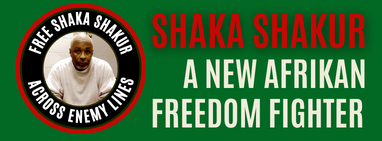
Editor’s note: This article first appeared in Iansá Magazine on December 3, 2025 under the title, “Shaka A. Shakur: Across Enemy Lines – the unfinished fight for freedom.
Introduction
In a nation that claims to have justice, due process, and equal protection under the law, the story of Shaka A. Shakur exposes the uncomfortable truth: some people are not simply imprisoned — they are targeted. Shakur’s decades-long battle with the prison-industrial complex reveals a system willing to break legal norms, psychological boundaries, and human rights whenever a New Afrikan freedom fighter refuses to submit.
Now imprisoned at River North Correctional Center in Virginia, Shaka remains not defeated, but keeping it moving straight ahead: with a new documentary, a new book, and a renewed campaign demanding his release. His case forces us to confront fundamental questions about justice in Amerika—and the cost of revolutionary resistance.
A Case Built on Repression, not Justice
Shaka was convicted in 2002 in Indiana on what supporters describe as a “trumped-up charge” of attempted murder of a police officer. His conviction did not come with the transparency or procedural fairness expected in a prosecution. Instead, Shaka became one more example of how due process can disappear when the state views someone as politically dangerous.
His supporters argue that the case was not about a crime — it was about punishment for being a vocal New Afrikan organizer, a student of revolutionary theory, and a political prisoner who refused to be silent.
Even in more recent legal efforts, due process remains elusive. In 2024, Shaka appealed constitutional violations connected to years of solitary confinement, loss of earned time, and obstruction of his legal work — only to have his claims dismissed on procedural grounds. The court concluded that full due process protections do not apply in prison disciplinary hearings, even when such hearings effectively extend imprisonment.
In other words: the state can add years to your sentence without giving you the rights you would have in a normal trial.
That contradiction already tells us everything about the system Shaka is fighting.
Revolution Wakes in the Dark: Shaka’s Political Development behind Bars
Shaka was first imprisoned at age sixteen — a child thrown into one of the harshest environments in Amerika. It was not the criminal legal system that shaped him, but the brutality of prison itself. At Indiana State Prison, Shaka witnessed what many describe as outright domestic torture:
- white supremacist correctional officers
- organized racism in administration
- beatings
- lynchings of Black prisoners
- systematic medical neglect
Rather than retreat, Shaka politicized himself. Older prisoners — veterans of the Black Liberation and New Afrikan Independence Movement — recognized his fire and helped cultivate it. Over time, he became a prison organizer, educator, and a voice of resistance.
His activism led to his placement among the “Indiana 6,” a group of politically conscious prisoners transferred to the notorious Westville Control Unit supermax — a move understood as retaliation, not a security necessity.
During this time, Shaka helped bring national attention to Indiana’s supermax through Human Rights Watch’s groundbreaking report Cold Storage. The report exposed the violent, psychologically destructive conditions Indiana used to silence prisoners like him.
Through these efforts, the state began to recognize Shaka not as an inmate — but as a threat to their control.
Domestic Exile: Isolation as a Weapon
In 2018, Shaka was abruptly transferred out of Indiana and sent to Virginia in a cross-state prisoner swap — a practice many activists call “domestic exile.” These transfers are not random; they are strategic. They isolate politically active prisoners from their support networks, families, and legal teams.
During the move, Shaka lost access to:
- legal documents
- evidence for ongoing cases
- religious materials
- manuscripts
- personal property
- and years of research
His supporters argue that this deprivation is part of a broader strategy: disrupt his legal efforts, suppress his writings, and weaken his ability to advocate for himself and others.
Exile may have been the state’s strategy — but it did not silence him.
Grief Behind Walls: The Psychological Toll
One aspect of Shaka’s story often overlooked is the profound emotional trauma he carries. Shaka’s son was murdered after Shaka had just came home from prison 2000-2001, This murder from reactionary violence of his only child happen a day before Shaka’s first birthday home in 18 years on the streets and with his son. The pain of losing a child is unimaginable — but to endure that without the ability to grieve properly, becomes a cruelty of its own. Shaka had only been home 10 months. This time line and frame matters especially to what would become of his psychological state. Depression, PTSD, all became factors of deterioration of his mental health.
This mirrors cases such as Rodney Hinton Jr., where grief, trauma, and incarceration collide in ways the system refuses to acknowledge. Shaka has written openly about the psychological toll this placed upon him, describing grief as both a wound and a catalyst for deeper political clarity.
His writings show a man who has suffered, but not surrendered — a man who has turned grief into commitment, loss into sharpened purpose.
This represents the ongoing generational omittance of New Afrikan/Black men mental health and the lack of due process within a judicial system that don’t see black men as human beings.
Shaka’s struggle and case hopes to bring focus on this injustice that’s been going on far too long.
A New Era of Resistance: Film, Literature, and the Fight for 2025
Despite every attempt to silence him, Shaka enters 2025 with two major cultural works that will amplify his voice far beyond prison walls.
Across Enemy Lines (2025)
His new documentary explores his life, political development, and the state-sanctioned repression he has survived. More than a biography, it’s an indictment of the prison system and a testimony to the strength of revolutionary consciousness under attack.
Manifestations of Thought: When the Dragon Comes (2025)
Set for release in December 2025 by 1804 Books, this is Shaka’s most significant body of writing to date — a collection of essays, reflections, and political analysis. With a preface by Haki Shakur, the book introduces readers to the depth of Shaka’s intellect, his revolutionary discipline, and his ability to turn lived experience into transformative theory.
Together, the film and book open a new chapter in the movement to free Shaka — and in the fight for abolition, justice, and New Afrikan liberation.
How to support Shaka Shakur right now!
This is not a symbolic struggle. Shaka’s freedom depends on action — collective, organized, persistent.1
A public petition has been launched demanding Shaka’s release and return to Indiana. More signatures mean more political pressure.
2. Write letters
Letters to prison officials, state legislators, governors, and parole boards make an impact. They show that Shaka is not forgotten — and that the public is watching.
Shaka is still engaged in legal battles. Donations to his legal-defense campaign support the attorneys and filings necessary to fight his case.
4. Organize screenings and discussions of the new documentary
When Across Enemy Lines releases, community screenings can spread awareness and build solidarity [plus raise funds for his legal campaign. If you’re interested in scheduling a screening with panelists, fill out this form!]
5. Read and circulate his work
Sharing Manifestations of Thought helps bring Shaka’s political analysis to the next generation of activists, scholars, and organizers.
Every act of support disrupts the silence the system tries to enforce. You can also find his writings and statements at the website of the Shaka Shakur Freedom Campaign.
Conclusion: A Life that Refuses to Break
Shaka A. Shakur is one of the most significant political prisoners of our time — not because he sought that role, but because the system recognized the danger of an educated, organized, unbroken Black revolutionary.
His journey is not merely a story of survival.
It is a blueprint of resistance.
A confrontation with state slavery.
A testament to what cannot be caged.
2025 going into 2026 may be the year his voice reaches farther than it ever has — and the year his fight for freedom becomes impossible to ignore.
To fight for Shaka is to fight for justice.
To fight for justice is to fight for all of us.
Free The Land!
Stand Up Struggle Forward!
Haki Kweli Shakur
August Third Collective
11-28 60 ADM