
Editorial Introduction
On November 11, 2026, Indianapolis was honored to hear from Shaka A. Shakur’s comrade and the first Indianapolis-Marion County exoneree, Leon Benson at a special screening of and panel on the new documentary, “Across Enemy Lines: Shaka A. Shakur.” Leon was a featured panelist alongside Nino Brown (Jericho Chicago and Party for Socialism and Liberation), Stephen Lane (Indy Liberation Center), Rev. Davanta R. Scruggs (Justice for Dalys Jett Spokesperson and Organizer), Derek Ford (Shaka Shakur Freedom Campaign), and Daissy Cook (Indy Hope Packages).
Benson served 25 years–over half of his life–incarcerated for a crime he didn’t commit because IMPD officers wanted to protect the real killer who was working for them as a snitch. Leon was finally exonerated on March 8, 2023. His first return to Indianapolis was organized with and hosted at the Indy Liberation Center, which has had the privilege of continuing to organize alongside Benson and his important campaigns, like the Solitary Justice Project and others. Benson met Shaka in prison first through his writings and later as a voice when they were on the same solitary cell range.
In his speech, Benson talked about what Shaka means to him and the world, and why we need to do everything within our power to free him now. Below is a lightly-edited transcript of his remarks and following that is a video of Benson’s remarks that you can watch and share).
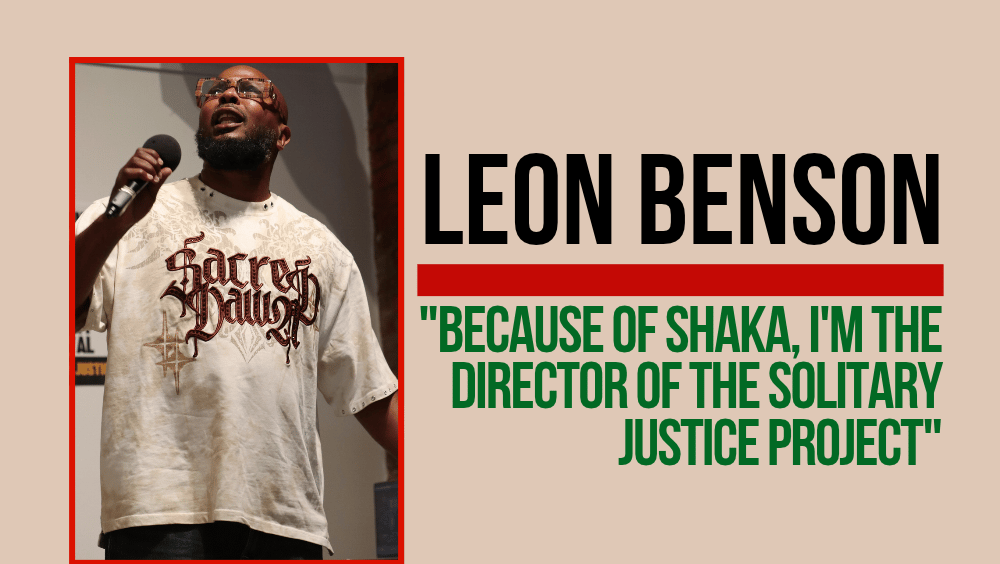
“Because of Shaka, I’m the Director of the Solitary Justice Project”
Uhuru Sasa. Greetings. Freedom Now. Live from Detroit, Michigan, my name is Leon Benson, and I’m honored and disgusted at the same time to speak on behalf of a brother and comrade of mine named Shaka Shakur.
He’s been in prison for a long time for trumped-up charges that are due to normal mental wellness issues that stem from being a victim of mass incarceration, of solitary confinement. And as I sit here and I think about the struggles that he still goes through today in Virginia and elsewhere, I am so disgusted by this. We need to do better as a system to restore the lives of people that encounter it. Had Shaka Shakur received the proper support upon being released even before coming out, I mean, it’s a great possibility that he wouldn’t be sitting in prison now. But then we got the other side, the prison industrial complex, that’s really suppressing him because he chooses to speak out about issues that are affecting New Afrikan people, other prisoners in general, and just humanity altogether.
Right now, when I think about the first time I met Shaka… honestly y’all, I’ve never physically touched Shaka Shakur, but it feel like he’s one of my closest brothers. First, I encountered him when I went to prison population. When I first came to prison, someone seen me really advocating for my case, advocating for issues around prison and things like that, and they said: “You should check out a Shaka Shakur pamphlet. Use this as a blueprint in your campaign.” So, I got this literature that Shaka had written years before he was released from prison. And I used this as a blueprint, you know, and I heard a lot of great things about him, about the work that he did on the inside, advocating for others. And I had this literature, I used it.
And as fate would have it, two years later I met Shaka on solitary confinement as a voice. “Hey, I’m Shaka.” I’m like, “Hey, what’s going on? I got your pamphlet.” I shared it with him and that’s where… I learned a lot from him. Not just sitting on the same solitary cell range, but when we used to exercise. They had an exercise door that would allow you to hear the person next door. And during them times that we could get rec and that we met with each other and we could talk through the door, very powerful conversations, you know? He really helped me to learn how to organize around these issues—prison and other issues—that were going on in society.
Because of that experience and me seeing the things that he was able to accomplish while oppressed like that, I’m the director of the Solitary Justice Project here in Detroit. And, you know, I’m partly inspired by Shaka’s documentary. Because it takes people to paint a picture and he painted a picture of what is exactly happening to him in in this system. After that is when I founded the Solitary Justice Project because I’d seen it firsthand. That was an experience of somebody that I actually knew in solitary confinement, that I never touched, that in many instances has been back in that situation again and is still incarcerated period. And so, it really motivated me to want to do something to connect with people, to get this story out, to advocate, and push the right buttons against the oppositional system that’s in the way, that lacks humanity.
I encourage everybody that’s seen this documentary, that’s going to see it, to sit down and reflect on what the human spirit goes through, and you know, that’s Shaka Shakur. I know he’s a great political theoretician, writer. Read his latest book. But he’s a human being.
And what I know that Shaka probably cannot articulate is, for me coming out that situation, looking back, it’s far worse than what I ever could imagine… Looking at it from the outside.
We got to come in to do more than just see these films: Act on the information out there because it’s real lives that are at stake. Shaka is one of many. So, I just want to thank y’all for allowing me to speak on his behalf, to advocate for him, and to tell you that he’s somebody worth supporting. He’s somebody worth standing behind. And he’s an asset. When he gets out of prison, he’s going to do a lot of great things that will uplift the community from his particular struggle.
But as I sit out of it now and being his kindred, it’s a very terrible situation. While you in it, you can’t see it and see how bad it is. But Shaka is speaking out more than most. So please, let’s do what we can to come together, continue to build solidarity from Michigan to Virginia to Indiana, California, New York, Illinois, everywhere… And come together and, really, let’s make something move on this case to bring him home.
I want to thank y’all for having me. I look forward to hearing your responses and, you know:
Uhuru Sasa! (that’s “Freedom Now!”)
La Lucha Continua!” (that’s “The Struggle Continues!”)
But we can continue in unity instead of separation.
Peace,
Leon Benson
11 November 2026
The Living Room Theaters
Indianapolis, IN
Watch and Share Leon Benson Speak on his Comrade Shaka A. Shakur!
Photo: Leon Benson performing at “Common Unity 3” at the Indy Liberation Center. Credit: Leon Benson/Indy Liberation Center.