
Editorial Note: Hear Shaka Read the Statement Below the Text
Introduction
Prison repression in the age of technology allows the state to engage in official misconduct, indulge in human rights abuses, and engage in targeted repression while simultaneously pretending to have clean hands. It’s almost the equivalent of carrying out a drone strike from another continent in a way, while utilizing satellite imaging and other technologies coordinated.
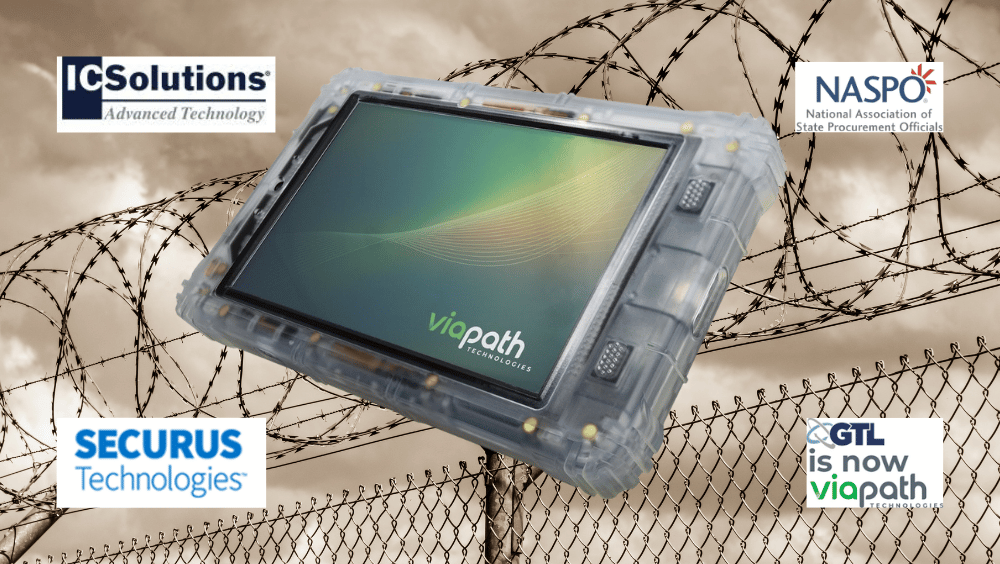
Many of today’s Department of Corrections are implementing the tablet system of facilitating both communications and programs while utilizing private companies such as GTL/Viapath, Securities, Advanced Technologies Group, LLC, etc., who have a certain blood-sucking parasitic relationship and monopoly with most Department of Corrections. And who also rake in millions of dollars from the parasitic and opportunistic relationship [1].
The Double-Edged Sword
On the surface, and to the average layperson or citizen, the tablet program appears to be a win-all for the prisoner, when in fact it is a double-edged sword that cuts both ways as far as positives and negatives
Some of the positives are that it becomes easier and convenient to communicate with your family. You can sit in your cell, room, or whatever and make calls. In some instances, you can have a virtual FaceTime video visit. You can have access to the law library. Some approve electronic books, e-books, etc. File requests to various departments and sometimes place your canteen and commissary orders, all while on your tablet. It all depends on what apps have been placed on the tablet and what apps have been approved.
On the flip side, it is being used as not only a tool of control, but also a tool of surveillance. It is also a tool of super-exploitation. In the case of the Virginia Department of Corrections, we are required to pay 20 cents per text message to be sent out, to look at our photos in a photo gallery app, to play music, to watch music videos, play games, view approved broadcasts, etc., we are being required to pay 4 cents a minute.
In fact, some of the same apps that are free to you on your phone or device, we are being charged for, often without the Department of Corrections even having approval from these companies to be charging for the use of their free app.
But you sit there and you call us criminal.
As far as our families?
For our families to even be allowed to sign up on these platforms, to be able to support their loved ones, virtually visit, send messages, and more, they are required to upload all kinds of personal information. They must, in fact, submit photos of their license, in some cases upload a picture of their passport, and all kinds of other personal and private info, just to be able to support and interact with their incarcerated loved ones.
How do our family and friends know that this info is being protected? What database is this info going into? Who has access to this database? Is this database being shared with or sold to other companies? What other government or law enforcement agencies have access to these databases? And why is so much detail and information being required from a law-abiding citizen, from a company that has a contract with a state agency, such as a Department of Corrections?
While it doesn’t appear that these requirements are required and uniform across the country, and that it varies from one state to another, who sets the criteria to determine what and which Department of Corrections or state will require such info, and whose interest and for what purpose is it being required?
The above is only one form of the government-style surveillance in this hyper-security police state that is being manufactured and, more and more, invading the private space and lives of the average so-called citizen. It’s interesting how we went from cameras on top of light poles in so-called high-crime areas to cameras on light poles everywhere, flock cameras, license plate readers, scanners, doorbell cameras, cameras on vehicles, drones listening and taking pictures recorded as they fly over neighborhoods, how databases for food or library check-out lists, online shopping, what you buy, eat, and even shit is being put in the databases.
In Prison, all Aspects are Intensified and Magnified
In a prison system, it is even more magnified and concentrated. For example, who is signed up on your email contact list? Who are you calling? What are you saying in your emails as the threads are digitized? What movies are you watching? Your online searches. There’s an app created for your contacts, and it automatically tells you the name and the phone number and location of your contact and allows an unsecured platform managed by a weak Wi-Fi systems and defective software programs being susceptible to being hacked and penetrated at the expense of us and this treasure trove of data and information.
This doesn’t even begin to speak to the opportunity to target and increase levels of oppression and surveillance of targeting individuals of political prejudice, for example. What’s supposed to be a First Amendment right and that of freedom of speech gets tossed out the window under the guise of security or corrections. Political expression and or criticism of the state becomes flagged and delayed for days, if not weeks, and either not allowed in or not allowed out without any kind of notification. Just general emails and the text messages to your wife, girlfriend, or whoever are flagged for no apparent reasons. Pictures, photos of no consequence are flagged and often not processed are withheld for weeks or without notification or justification, all in violation of the Virginia Department of Correction policy, leaving us and our families or our families very little resource to address or resolve these issues.
In general, the Wi-Fi fluctuates in various parts of the prison, but it also is also controlled and used as a weapon to target those who are politically active. Jailhouse lawyers are engaged in other activities that are supposed to be allowed. Whether control of such or the use of such is allowed or disallowed based upon the whim of the controller or the mandate from the above higher-ups. Be critical of DOC policies or unprofessional conduct? No Wi-Fi. Be politically engaged? Have an event where you’re scheduled to speak or be on part of a panel and your Wi-Fi is turned off.
Be on the hate list of various captains, lieutenants, sergeants, and you are at the mercy of those forces as to whether or not you will have access to your Wi-Fi. At the mercy or at the mercies of these proxies who collaborate and serve both the interests and agenda of the state.
For those that don’t know, there’s an organization called the National Association of State Procurement Officials. The acronym is N-A-S-P-O. This represents what they call offers a simple solution. NASPO administers a master agreement for phone and tablet services that other prison systems can join. The turnkey contract provides an easy way for states to get tablets to their prison populations by signing on to the master agreement, allegedly, and selecting the vendor, pricing, and optional services.
A DOC can choose among five vendors: GTL/ViaPath, Securus Technologies, Advanced Technology Group, LLC, Inmate Caller Solutions (ICS), The NASPO receives 1% of gross revenue from all products and services provided under the agreement as an annual fee.
The NASPO master agreement specifies that phone calls made by prisoners shall be recorded and stored for the life of the contract with calls recorded and details retained for four years after the contract ends. Now listen to that.
They get to hold on to these recordings and they store them not only for the life of the contract, but also with these records and details being stored for four years after the contract ends. Video sessions will be recorded and stored for at least 90 days. Electronic messages are likewise retained and kept in a database that can be searched by keywords. Photos and video attachments sent by family members are stored too.
The NASPO agreement states that tablet vendors must provide correctional vendors with the ability to track, research, and investigate messaging history by various factors, including but not limited to the send data, the sender, the recipient, etc.
Scanned incoming mail is also stored in the searchable databases. That allows prison and jail officials to review and monitor prisoners’ personal correspondence. According to the NASPO agreement, scanned mail would be kept online for at least a year with record details; for example, sender and recipient stored for another four years.
The original letters, hand copies, hard copies will be retained for one year and are considered property of the corrections agency, Now, we are led to believe that when we get photos, which are photocopied and scanned and given to us, that the original photos are destroyed, just as we are led to believe that when we get letters, which are photocopied and scanned, the original letters are destroyed. We’re now being told and informed that these letters and these hard copy letters and these photographs are being placed in databases and folders and files without our consent or the consent of those that are sending them.
All of these companies overlap, merge, separate, and monopolize. JPay/Securus Technologiesm, in its vaguely-stated privacy policy, that the user data may be shared with law enforcement personnel and or correctional facilities and certain third parties for use and connection with and in support of law enforcement activities.
GTL/ViaPath states data collection will enable correctional facilities to easily review and analyze the networks, relationships, and corrections and connections associated with their inmate population.
And by extension, the people that prisoners communicate with on the outside, which again is a violation of the people on the outside, the citizens’ rights who have not given consent or approval or not violated any laws.
Call to Action Now! Defend Basic Democratic Rights
We’re asking for inquiries to be made and complaints to be filed to the Consumer Protection Agency on my behalf, on our behalf, as well as for people to contact the Office of the Inspector General for the State of Virginia. You can find the relevant information below, as well as online submissions forms for filing complaints.
We’re also looking for legal representation who may be interested in filing a class action lawsuit for violation of contract, breach of contract, violation of consumer protection laws, etc. To inquire about legal representation, keep scrolling.
Shaka A. Shakur
06 July 2026
Act Now: Who to Contact and File a Complaint or Raise a Concern
Office of the State Inspector General (Virginia)
Phone: 804-625-3255
E-mail: osig@osig.virginia.gov
State Fraud, Waste and Abuse Hotline (Virginia)
Phone: 800-723-1615
Email: COVHotline@osig.virginia.gov
Online Complaint Form: https://www.osig.virginia.gov/program-areas/citizen-services/state-fraud-waste-and-abuse-hotline/complaint-form/
Corrections Ombudsman Unit (Virginia)
Phone: 833-351-6640
Email: ombudsman@osig.virginia.gov
Online Complaint: osig.virginia.gov/complaint-forms/ombudsman-complaint-form/
References
[1] Prison Legal News, “Pay-for-Play Tablets: The Costly New Prison Paradigm,” Prison Legal News, 01 March 2025. Available here.
Shaka Speaks on Prisons in the Digital Age